01
Six Things to Compare
All Hall-effect thickness gauges work the same way: a steel target ball on one side of the wall, a magnetic probe on the other, and a sensor that reads the gap between them. The differences that matter to a buyer are in the six points below. Ask every supplier the same six questions and the quotations become comparable.
- —Thickness range. Start from the thinnest and the thickest wall you measure today, plus what is planned. The top of the range depends on the ball: a larger ball reaches a thicker wall.
- —Accuracy basis. A percentage of reading shrinks with the wall; a percentage of full scale does not. Check also whether the figure is for basic or for multi-point calibration.
- —Target balls included. How many ball sizes come as standard, and which are extras. Tight corners and grooves need the small ball; thick bases need the large one.
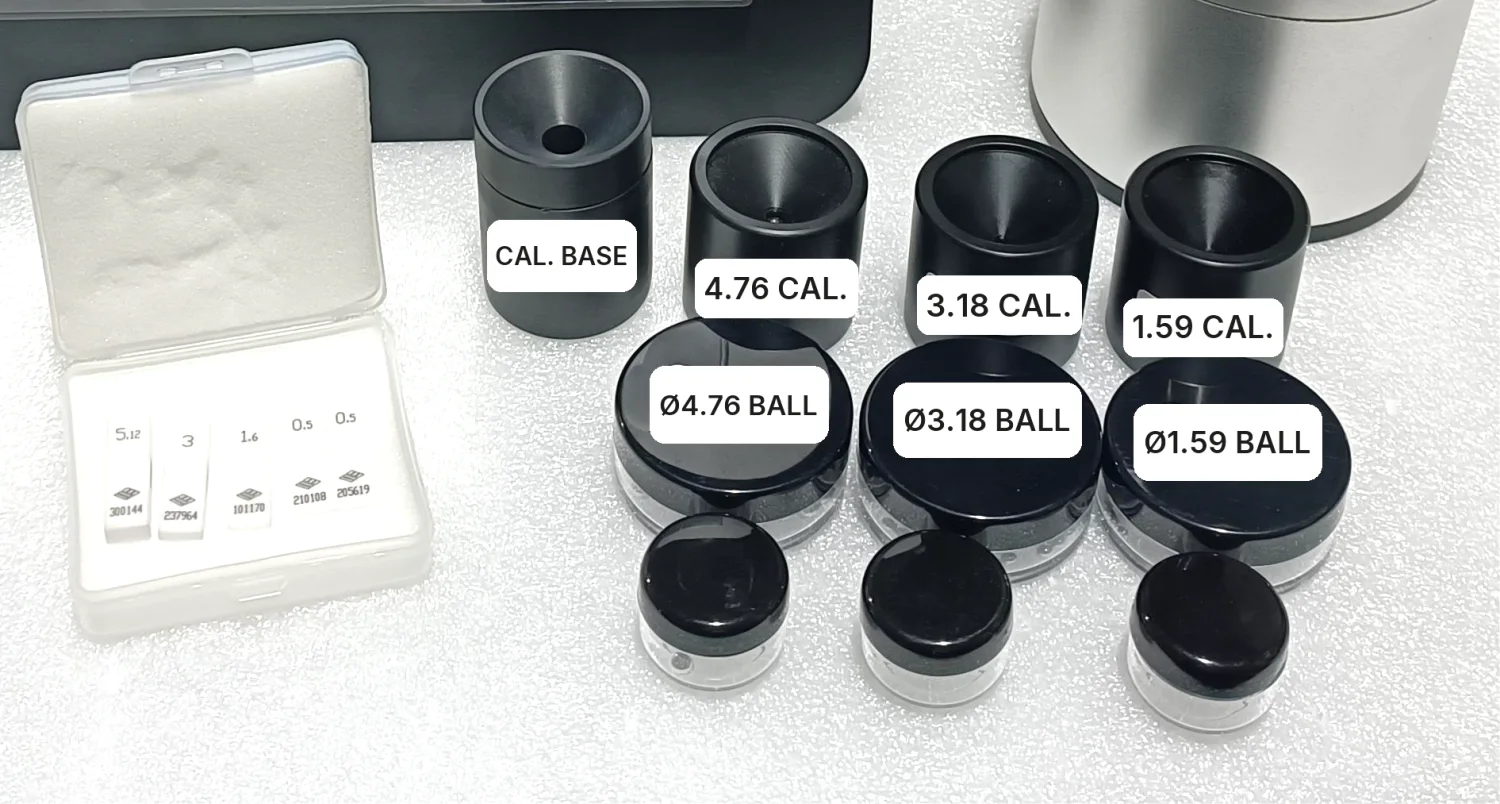
- —Calibration parts. Are the zeroing fixture, the fixtures for each ball and the thickness shims in the box, or priced separately?
- —How readings are recorded. Live value only, or maximum, minimum and average as well? Is there memory, a data output, software, a printer?
- —Power supply. Mains only or battery as well, and does it accept your mains voltage and frequency without a transformer?
02
Start From Your Wall Thickness
Most bottle and container work sits well inside the standard balls. On the KHT MTG-100 the 3/16" (4.76 mm) ball covers 0.100–6.350 mm, which takes in the body, shoulder and base of typical plastic and glass packaging. Thick-walled parts are where gauges differ: look at the maximum thickness and at which ball or special target is needed to reach it.
Do not buy range you will never use. A gauge that reaches a very thick wall does so with a larger ball, and a larger ball does not sit in a tight corner or a narrow groove.
03
KHT MTG-100
Our own gauge, listed in the same layout as the others so that you can compare like with like. The full specification is on the datasheet.
| Item | Published figure |
|---|---|
| Standard target balls | 1/16" (1.59 mm), 1/8" (3.18 mm), 3/16" (4.76 mm) |
| Other targets | Optional: 5.00 mm magnetic ball, 7.00 mm magnetic ball |
| Thickness range | 0.100–2.590 mm (1/16" (1.59 mm)); 0.100–4.570 mm (1/8" (3.18 mm)); 0.100–6.350 mm (3/16" (4.76 mm)); 4.00–19.00 mm (5.00 mm magnetic ball); 4.00–25.4 mm (7.00 mm magnetic ball) |
| Accuracy, basic calibration | ±3% to ±4% of reading |
| Accuracy, multi-point calibration | ±1% to ±3% of reading |
| Resolution | 0.01 or 0.001 mm |
| Calibration parts in the box | Zeroing fixture, a calibration fixture for each ball size, calibration thickness shims |
| Readout | Live value + max / min / average |
| Power | 100 - 240 V, 50 - 60 Hz |
| Size and weight | 250 × 120 × 220 mm; 4 kg |
04
Evident Magna-Mike 8600
Figures as published by Evident Scientific (formerly Olympus) on its product page [1], read on 2026-09-19. Check the maker's page for the current data before you decide.
| Item | Published figure |
|---|---|
| Standard target balls | 1/16 in. (1.58 mm), 1/8 in. (3.17 mm), 3/16 in. (4.76 mm), 1/4 in. (6.35 mm) |
| Other targets | Magnetic balls 3/16 in. and 1/4 in.; flat and V-edge disks; wire targets |
| Maximum thickness | 2.03 mm with the 1/16 in. ball, 6.1 mm with 1/8 in., 9.1 mm with 3/16 in. and 1/4 in.; 25.4 mm with the 1/4 in. magnetic ball |
| Accuracy, basic calibration | 4% (1/16 in. and 1/8 in. balls), 3% (3/16 in. and 1/4 in. balls) |
| Accuracy, multipoint calibration | 3% (1/16 in.), 2% (1/8 in.), 1% (3/16 in. and 1/4 in.) |
| Resolution | 0.1 mm, 0.01 mm or 0.001 mm, depending on thickness range |
| Probes | Straight, right-angle and low-profile articulating |
| Data | Internal data logger; MicroSD card; USB and RS-232 |
| Power | AC mains 100–120 VAC / 200–240 VAC; optional lithium-ion battery, 16 h |
| Size and weight | 236 × 167 × 70 mm; 1.68 kg including battery |
05
CanNeed MBT-300
Figures as published by Canneed Instrument on its product page [2], read on 2026-09-19. Check the maker's page for the current data before you decide.
| Item | Published figure |
|---|---|
| Standard target balls | 1/16 in. (1.59 mm), 1/8 in. (3.18 mm), 3/16 in. (4.76 mm) |
| Other targets | 5.00 mm and 7.00 mm magnetic balls |
| Thickness range | 0.100–2.590 mm (1/16 in.), 0.100–4.570 mm (1/8 in.), 0.100–6.350 mm (3/16 in.); 4.00–19.00 mm (5.00 mm magnetic ball); 4.00–25.4 mm (7.00 mm magnetic ball) |
| Accuracy, single-point calibration | ±4% (1/16 in. and 1/8 in.), ±3% (3/16 in. and magnetic balls) |
| Accuracy, multi-point calibration | ±3% (1/16 in.), ±2% (1/8 in.), ±1% (3/16 in. and magnetic balls) |
| Resolution | 0.01 mm or 0.001 mm |
| Calibration | Two-point, or multi-point with up to 9 reference points |
| Data | Stores 95,000 readings; RS-232 output |
| Power | 100/120/220/240 VAC, 48–62 Hz; rechargeable Ni-Cd battery, 8–16 h |
06
ElektroPhysik MiniTest FH
Figures as published by ElektroPhysik on its product page [3], read on 2026-09-19. Check the maker's page for the current data before you decide.
| Item | Published figure |
|---|---|
| Maximum thickness | Up to 24 mm, depending on the sensor |
| Sensors | FH2, FH4 and FH10 families, straight and 90° versions; a wire-target version |
| Target balls supplied | Depends on the sensor; for the FH4: 1.5 mm, 2.5 mm and 4 mm steel balls |
| Calibration parts supplied | Precision standards and zero calibration standards for each ball size, per sensor |
| Measuring rate | Up to 20 readings per second |
| Data | 2 million readings in more than 200 batches; Bluetooth, USB and RS-232 |
| Power | 8 AA NiMH batteries, charged over USB |
| Protection | IP 65 |
07
How to Read These Tables
The tables repeat what each maker publishes; they are not test results, and we have not measured the other gauges. Makers do not all publish the same items, so an item missing from a table means only that it was not on the page we read.
Where two gauges list the same accuracy figure, check that both are stated on the same basis and for the same calibration method. Where they list different maximum thicknesses, check which ball or target each figure belongs to.
If you already use an older gauge of this type and are replacing it, send us the ball sizes and the thickness range you work with. We will tell you plainly whether the KHT MTG-100 covers it.
Full specification and datasheet: KHT MTG-100 product page on packagingtestequipment.com