01
Three Ways to Measure a Wall
Search for "wall thickness gauge" and nearly every result is an ultrasonic gauge. It is the best-known method, but it is one of three, and for bottles it is often not the most convenient.
- —Ultrasonic: a transducer sends a sound pulse through the wall and times the echo from the far side. [2]
- —Hall-effect (magnetic): a probe on one side reads the distance to a steel target ball on the other side. [1]
- —Contact: a micrometer, caliper arm or dial gauge physically touches both surfaces.
02
Side-by-Side Comparison
| Hall-effect | Ultrasonic | Contact | |
|---|---|---|---|
| What it reads | Distance from probe to target ball | Echo time × sound velocity of the material | Mechanical gap between two anvils or arms |
| Couplant | Not needed | Needed — a drop of liquid between transducer and part [3] | Not needed |
| Material setup | None; any non-magnetic material | Gauge must be set to the sound velocity of each material [4] | None |
| Access needed | Both sides (ball goes inside) | One side only [2] | Both sides; arms must reach, or the part is cut |
| Magnetic materials (steel) | Cannot measure | Can measure | Can measure |
| Maximum thickness | About 25 mm; KHT MTG-100: 25.4 mm with optional balls | Far higher — hundreds of millimetres on suitable materials [2] | Set by the throat depth of the tool |
| Corners, grooves, shoulders | Ball rolls into them | Sensitive to curvature, taper and alignment [5] | Often out of reach |
| Destructive? | No | No [2] | Often yes for closed shapes |
03
Why Ultrasonic Takes More Care on Bottles
None of this makes ultrasonic gauging a poor method — it is the standard for pipes, tanks and plate. The extra care comes from how it works.
Sound in the megahertz range does not travel efficiently through air, so a drop of coupling liquid is needed between the transducer and the part for every reading. [3] On a production floor that means applying couplant to, and wiping it off, each bottle you check.
The gauge converts echo time into thickness using the speed of sound in the material, so it has to be programmed with that speed, and the speed depends on the material. [4] A plant running PET, HDPE and glass needs a setup for each. Some plastics also attenuate sound quickly at the frequencies used. [5]
Geometry matters too. The best ultrasonic accuracy is obtained when both surfaces are smooth, and on curved surfaces the transducer has to be held on the centreline and normal to the radius; tapered or eccentric walls reduce the returning echo. [5] Bottle shoulders, bases and handles are exactly those shapes.
04
Where a Hall-Effect Gauge Fits
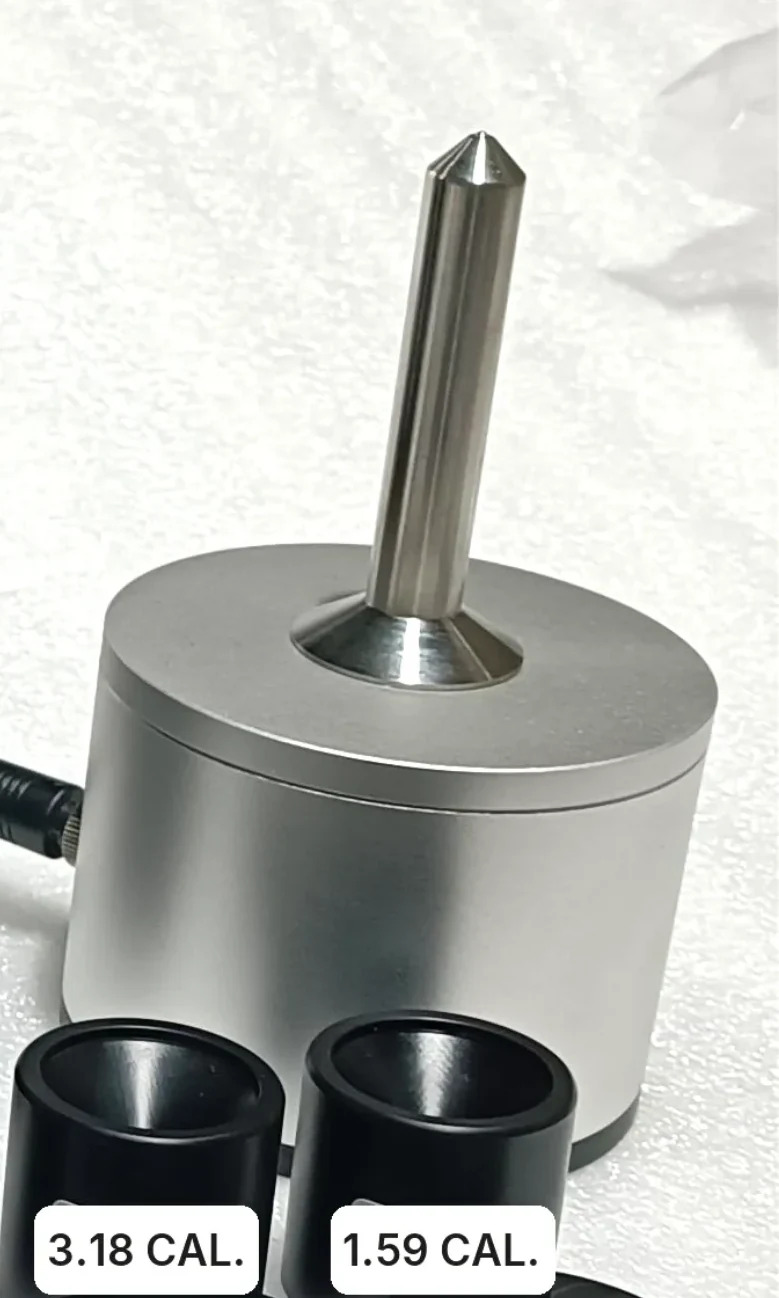
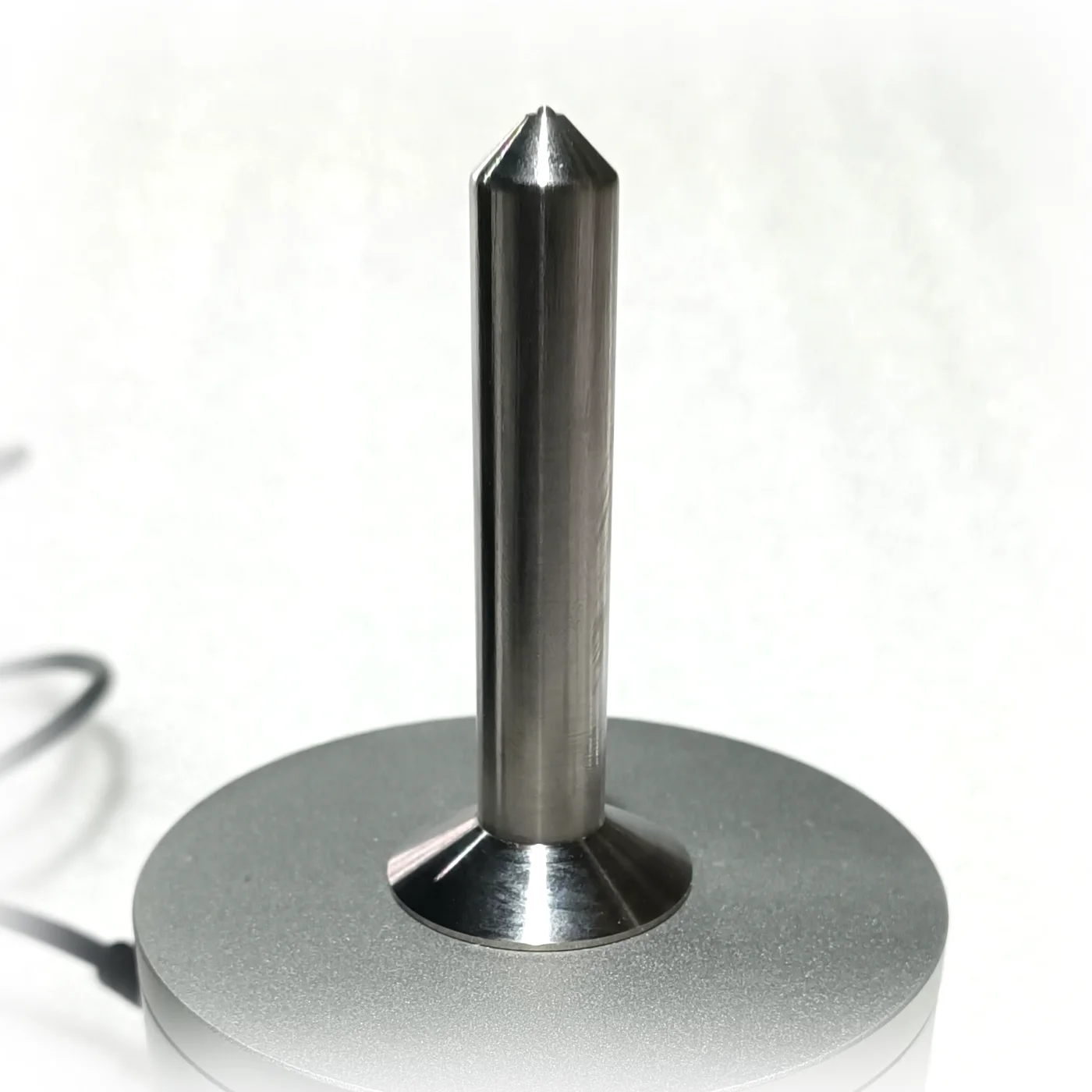
A Hall-effect gauge reads a physical distance, so the list above does not apply: no couplant, no velocity table, and the shape of the part does not affect accuracy. You drop the ball in, move the part over the tip of the bench-mounted probe, and watch the live value while the gauge captures maximum, minimum and average.
The KHT MTG-100 is built for this job: bottle wall and bottle base thickness on plastics, glass, composites, aluminium and titanium.
05
When Ultrasonic Is the Right Choice
- —You can reach only one side of the part — a sealed tank, a pipe in service, a large closed vessel.
- —The material is steel or another magnetic metal.
- —The wall is thicker than about 25 mm.
- —Internal ribs or baffles would stop a target ball reaching the spot you need to measure.
06
What About Contact Gauges?
A micrometer or a dial gauge with caliper arms is direct and inexpensive, and for flat sheet or for the open rim of a container it is often all you need. The limit is reach. To measure halfway down a narrow-necked bottle, or in the corner of a base, the arms have to get there — otherwise the bottle is cut open, and the sample is lost.
A practical split is a contact gauge for quick rim and sheet checks, and a Hall-effect gauge for the body, shoulder and base.
07
A Simple Way to Decide
- —Hollow non-magnetic part with an opening, wall up to 25 mm → Hall-effect.
- —Only one side accessible, or steel, or a very thick wall → ultrasonic.
- —Flat sheet, or an edge you can reach with a micrometer → contact gauge.
Full specification and datasheet: KHT MTG-100 product page on packagingtestequipment.com
Sources
- Evident Scientific — Introduction to Hall Effect Thickness Gaging
- Evident Scientific — Introduction to Ultrasonic Thickness Gauges
- Evident Scientific — Ultrasonic Thickness Gauges: Theory of Operation
- Evident Scientific — Ultrasonic Thickness Gauge Calibration
- Evident Scientific — Factors That Can Impact Ultrasonic Testing