01
Why Plastic Bottle Wall Thickness Is Checked
A blow-moulded bottle starts as a tube or a preform and is stretched into the mould. The plastic does not spread evenly: corners, the heel and the area around the base stretch the most and end up the thinnest. Those thin sections decide how the bottle behaves when it is stacked, squeezed, dropped or filled hot.
Stacking strength of blown containers is tested as column crush, or top load, to ASTM D2659, which is used for quality control and for acceptance or rejection under specifications. [2] A wall thickness check tells you why a bottle passed or failed that test, and it does so in seconds at the blow moulder rather than later in the laboratory.
Light-weighting makes the check more important, not less. Every gram taken out of a bottle comes out of the wall, so the margin between a good section and a weak one gets smaller.
02
Where to Measure on a Plastic Bottle
A useful routine covers the same points on every bottle, so that shifts and machines can be compared:
- —Shoulder — where the neck widens into the body.
- —Body panel — at two or three heights, and on opposite sides to catch an off-centre parison or preform.
- —Heel — the corner between body and base, usually the thinnest part of an extrusion-blown bottle.
- —Base — the feet and the centre of a PET bottle, or the pinch-off line of an HDPE bottle.
- —Handles, grooves and ribs — the ball follows the probe into places a micrometer cannot reach.
03
How the Measurement Is Made
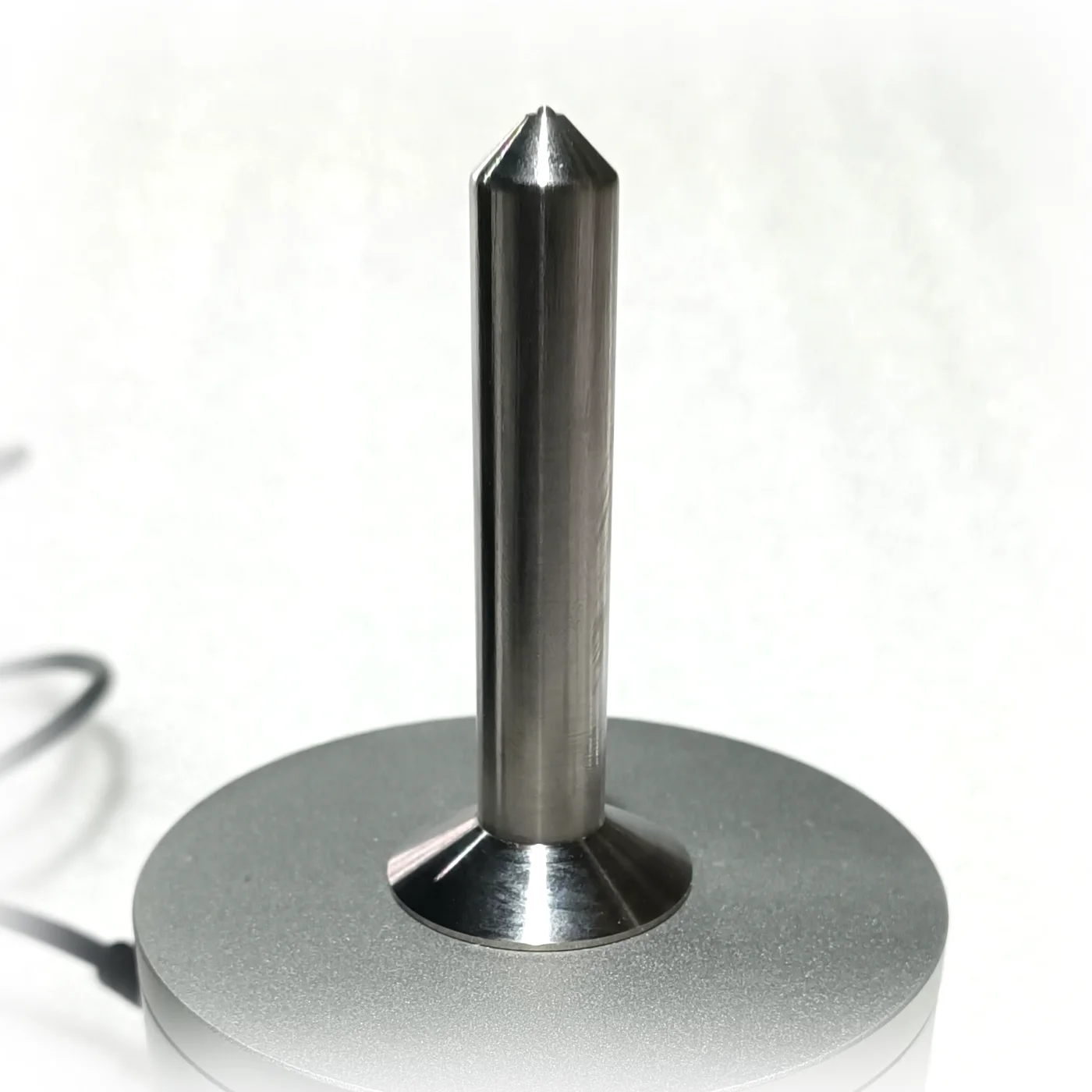
The probe of the KHT MTG-100 stands upright on its own base on the bench. Drop the target ball into the bottle and rest the outside of the wall on the probe tip. The ball is pulled to the point directly opposite the tip, and the screen shows the distance between them — the wall thickness.
Move the bottle over the tip to follow a line down the body or around the heel. The gauge shows the live value and captures the maximum, minimum and average as you go, so the thinnest point of a section is recorded without stopping to write anything down.
The reading depends only on the gap between probe and ball. Colour, transparency, fillers and barrier layers make no difference, and neither does the shape of the bottle.
04
Which Target Ball for Plastic Bottles
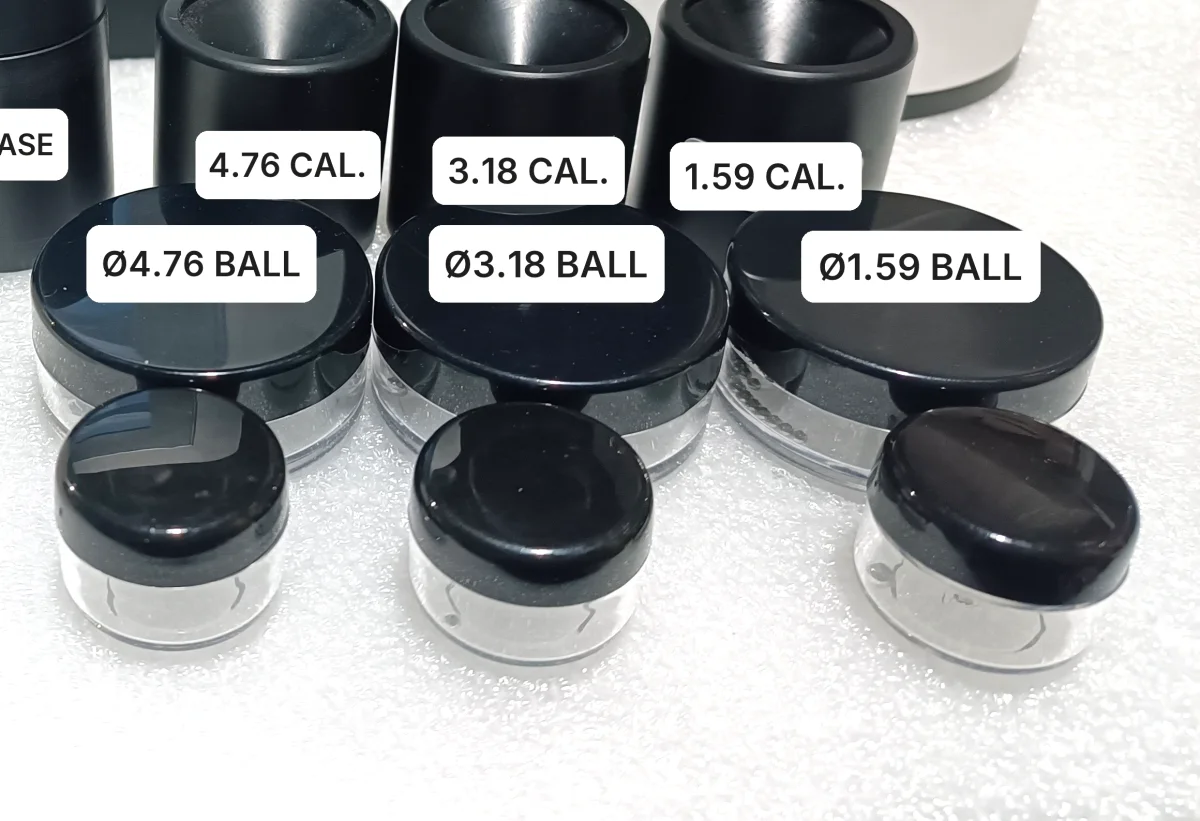
In general the best results come from the largest target ball that still moves freely inside the part. [1] For most bottles that is the 3/16" (4.76 mm) ball: it covers 0.100–6.350 mm and gives ±1% of reading after multi-point calibration.
Change to the 1/16" (1.59 mm) ball (0.100–2.590 mm) for tight heel radii, narrow grooves and small handles where the large ball cannot sit against the wall.
| Target ball | Thickness range | Basic calibration | Multi-point calibration |
|---|---|---|---|
| 1/16" (1.59 mm) | 0.100–2.590 mm | ±4% of reading | ±3% of reading |
| 1/8" (3.18 mm) | 0.100–4.570 mm | ±4% of reading | ±2% of reading |
| 3/16" (4.76 mm) | 0.100–6.350 mm | ±3% of reading | ±1% of reading |
| 5.00 mm magnetic balloptional | 4.00–19.00 mm | ±3% of reading | ±1% of reading |
| 7.00 mm magnetic balloptional | 4.00–25.4 mm | ±3% of reading | ±1% of reading |
05
From Small Bottles to 20-Litre Containers
Container size is not a limit of the method. The ball goes inside and the probe stays outside, so a 100 mL agrochemical bottle, a 5-litre jerrycan and a 20-litre drum are measured the same way; larger containers are simply lifted onto the probe by hand. The largest ball is only a few millimetres across, so it passes any bottle neck.
What matters is the wall itself. Standard balls reach 6.350 mm. For heavy-walled drums and tanks, the optional 5.00 mm magnetic ball (4.00–19.00 mm) and 7.00 mm magnetic ball (4.00–25.4 mm) extend the range to 25.4 mm.
06
What to Watch For
- —The ball must be free to reach the point opposite the probe. Internal ribs or a very tight corner can hold it back, and the reading at that spot will be too high. [1]
- —Keep the probe away from steel benches, brackets and tools while measuring; nearby magnetic objects disturb the reading. [1]
- —Calibrate with the same ball you measure with, and check the calibration again when the room temperature changes. [1]
- —A sealed container cannot be measured, because the ball has to get inside.
Full specification and datasheet: KHT MTG-100 product page on packagingtestequipment.com